



 2026/06/09
Preface
Driven by key national development strategies such as Saudi Vision 2030 and the UAE Net Zero 2050 Strategy, the GCC steel construction industry is enjoying steady long-term growth. As local climate requirements, green codes and various product certification rules keep getting stricter, traditional on-site welded PEB can no longer satisfy updated project requirements after decades of application. The whole industry steps into a critical upgrading period shifting toward factory-made bolt-connected construction. This report analyzes market expansion, typical construction troubles, unbalanced supply-demand structure and three mainstream industry trends, before introducing mature industrial building solutions matching Middle Eastern practical needs.
1. Market expands rapidly while access requirements keep rising
Driven by economic diversification strategies across Saudi Arabia, the UAE, and other GCC nations, the Middle East construction sector continues its robust expansion. Unlike short-term, oil-dependent infrastructure projects in the past, the current growth is backed by long-term national vision programs, delivering large-scale, high-standard, and sustainable development momentum. According to official 2025 data from SMM Global, regional steel demand in the Middle East will rise by 2.8% year-on-year to 59.5 million tons, with Saudi Arabia and the UAE contributing over 60% of total consumption, serving as the core growth engines for steel infrastructure and industrial park expansion across the Gulf region.
Specialized industry reports released by Mordor Intelligence further validate the market’s strong upward trajectory. In 2025, the GCC steel fabrication market reached $9.11 billion and is projected to surpass $11.7 billion by 2030, maintaining a steady 5.13% CAGR — one of the fastest-growing infrastructure segments worldwide. Fueled by Saudi Vision 2030 and the UAE 2050 Net Zero Strategy, massive urban renewal, industrial cluster development, new energy supporting facilities, logistics hubs, and commercial projects are being rolled out continuously. The large volume of standardized industrial and logistics developments has created strong, sustained demand for Pre-Engineered Steel Buildings (PEB), known for their high efficiency and cost competitiveness.
The underlying market logic has shifted from basic infrastructure development to quality-oriented upgrading. While traditional construction methods focused merely on completing building structures, modern projects prioritize construction efficiency, structural durability, carbon compliance, and long-term maintainability. Meanwhile, the Gulf region’s extreme climate poses severe challenges to building performance. Year-round intense heat, drastic temperature differences, frequent sandstorms, and high salinity in the air impose far stricter requirements on steel structures in terms of heat resistance, corrosion resistance, wind stability, and seismic performance. Conventional on-site casting and welding methods struggle with unpredictable construction schedules and frequently suffer from welding deterioration, structural deformation, and precision errors caused by harsh weather, leading to extremely high maintenance costs in later operation stages.
This explains why PEB solutions have long dominated the low-rise industrial and logistics building market across the GCC. Featuring standardized modular design, factory prefabrication, and rapid on-site assembly, PEB perfectly matches the Middle East’s demand for large-scale, fast-track, and cost-effective construction. It significantly shortens project delivery cycles and controls overall construction costs, making it widely recognized and adopted in local commercial and industrial developments.
Nevertheless, as regional construction standards iterate, green building policies tighten, and client quality expectations rise, the inherent limitations of conventional welded PEB are becoming increasingly prominent, based on 2025 industry trend reports from Technavio and Emergen Research. Market competition no longer focuses solely on speed and upfront pricing, but shifts toward comprehensive strengths including technical adaptability, low-carbon construction, structural durability, and delivery reliability. The entire industry has entered a critical phase of technological upgrading and transformation. In addition, tightened market access certification rules further lift market thresholds. GCC unified G-mark certification, Saudi SABER PCoC & SCoC clearance certification, UAE ECAS product approval and Qatar QCD certification have turned into mandatory tendering prerequisites. Meanwhile green building certifications including GSAS and Estidama are compulsory for most government-funded projects. Non-compliant products fail to pass customs clearance or project acceptance, accelerating the phase-out of unstandardized small-scale manufacturers. Meanwhile, Saudi Arabia’s ICV local content rules require fixed local procurement ratios for government-funded projects, further lifting market access costs for overseas component suppliers.
2. Three core construction difficulties restricting project progress
Despite the continuous expansion of the Middle East steel market, the industry faces a common dilemma: growing project volume without corresponding quality improvement. A large number of local developments suffer from delayed delivery, cost overruns, compliance risks, and frequent post-completion maintenance issues. According to 2025 Gulf engineering industry surveys, these challenges are not isolated cases, but structural problems arising from the mismatch between traditional on-site construction models and the region’s unique climate, labor conditions, and updated regulatory standards, directly affecting project profitability and compliant delivery.
2.1 Extreme climate narrows effective construction windows with minimal room for error
The Gulf region’s scorching summers and frequent sandstorms greatly limit outdoor working hours. Traditional PEB construction relies heavily on on-site welding, calibration, and anti-corrosion treatment — processes highly sensitive to temperature and air quality. High temperatures easily cause welding deformation and unbalanced structural stress, while sand contamination leads to slag inclusions and poor coating adhesion. These subtle construction defects result not only in schedule delays but also in irreversible long-term issues such as structural corrosion and reduced stability, explaining why many local steel buildings experience severe peeling, rusting, and deformation within 3–5 years of operation.
2.2 Shortage of skilled labor leads to uncontrollable labor costs and inconsistent quality
The GCC region faces a long-term deficit of professional steel structure workers, with high turnover among overseas labor teams. Salary data shows wages for skilled construction workers have risen by over 8% annually in the past three years, making labor one of the largest cost components after raw materials. Conventional welded PEB quality depends entirely on worker experience, resulting in inconsistent welding standards, uneven anti-corrosion performance, and unstable project quality. For general contractors, labor shortages not only drive up overall costs but also introduce huge delivery uncertainties. Restrictive overseas labor visa quotas across GCC nations further curb available on-site manpower and push labor expenses upward year after year.
2.3 Mandatory green policies expose traditional construction to compliance risks
Supported by Saudi Vision 2030 and the UAE 2050 Net Zero Initiative, GCC countries have upgraded green building and carbon emission regulations from optional guidelines to rigid enforcement standards. On-site welding generates intensive light pollution, industrial fumes, waste residues, and material cutting waste, which increasingly fail to meet updated green construction acceptance criteria, leaving conventional projects facing rectification penalties and certification obstacles. Besides, updated GSO anti-corrosion and fire-proof specifications require strict laboratory testing such as 2400-hour salt spray resistance. Unstable quality from field welding makes conventional PEB hard to acquire relevant product certifications, causing frequent project acceptance delays and financial penalties.
In essence, the flaws of traditional PEB stem not from the PEB concept itself, but from its heavy reliance on on-site welding, manual labor, and field management — a model fundamentally incompatible with the Middle East’s harsh construction environment. The industry urgently demands an upgraded construction logic that minimizes on-site welding, reduces labor dependence, and eliminates climate constraints to resolve core engineering challenges at the source. Beyond construction troubles, fragmented market segmentation and rampant low-bid competition create another major structural crisis within the sector.
3. Polarized market creates huge blank in mid-end demand
The GCC steel construction space is distinctly split into two isolated tiers, leaving a massive underserved mid-market segment and spurring destructive price-driven competition.
3.1 Low-end raw material trading segment
Local steel merchants solely focus on raw material sales without in-house structural design, engineering optimization or after-sales technical support. Clients are forced to adopt generic outdated PEB blueprints lacking climate-specific optimization, resulting in extreme product homogenization and reducing mid-market tendering to pure price wars.
3.2 High-end premium landmark segment
International top-tier engineering firms boast robust technical capacity yet exclusively target high-budget supertall and landmark developments with steep pricing and extended lead times, making their solutions unviable for mainstream mid-sized industrial and warehousing projects.
Per 2025 segmentation data from Mordor Intelligence, future market expansion will no longer be anchored by iconic high-end projects; incremental growth is concentrated within overlooked mid-market assets: SME production workshops, e-commerce and supply-chain warehouses, industrial park auxiliary facilities and small-scale renewable energy supporting buildings. This category features substantial order volumes, moderate capital outlay and consistent repeat demand, requiring balanced performance covering reasonable cost, fast rollout, long-term durability and green compliance.
Most fabricators still rely on decade-old generic PEB designs without Gulf climate customization. To win low-price bids, numerous manufacturers cut anti-corrosion investment. While such cost-cutting delivers roughly 10% upfront savings, subsequent repair costs can surge to over 35% of initial build expense within five years. Multiple Qatar warehouse projects prove this point: buildings with simplified anti-corrosion suffer widespread rust and leakage within 3~5 years, leading to expensive renovation or early demolition.
Real-world cases reshape local buyers’ procurement logic, who now evaluate upfront cost alongside construction efficiency and full-cycle maintenance expenditure. With few qualified upgraded PEB alternatives available, the mid-market represents a massive blue-ocean opportunity for innovative manufacturers.
4. Three Defining Industry Trends & Matching Industrialized Construction Solutions
Based on 2025–2030 forecasts from Technavio, Market Data Forecast and Mordor Intelligence, the Middle Eastern steel sector is shifting from price-centric competition to quality-driven upgrading, alongside stricter certification oversight. Factory serial production delivers consistent component quality, enabling bolt-connected construction to smoothly pass G-mark, SABER and ECAS certification, whereas inconsistent field-welded products repeatedly fail qualification testing.
Trend 1: Factory Industrial Prefabrication Replaces Labor-intensive Field Build
Large-scale GCC upcoming industrial projects are progressively adopting fully off-site prefabrication and modular assembly, phasing out extensive field welding and wet construction. Competitive advantage is now defined by factory precision and stable delivery performance.
Trend 2: Green & Low-carbon Build Becomes Mandatory Market Entry Criterion
Carbon neutrality policies elevate low-waste construction into compulsory acceptance standards, gradually disqualifying high-pollution field welding from mainstream tendering.
Trend 3: Climate-customized Design Forms Core Competitive Moat
Generic international design cannot withstand the Gulf’s extreme heat and sand erosion; future tender prioritizes heat-resistant, low-maintenance customized solutions.
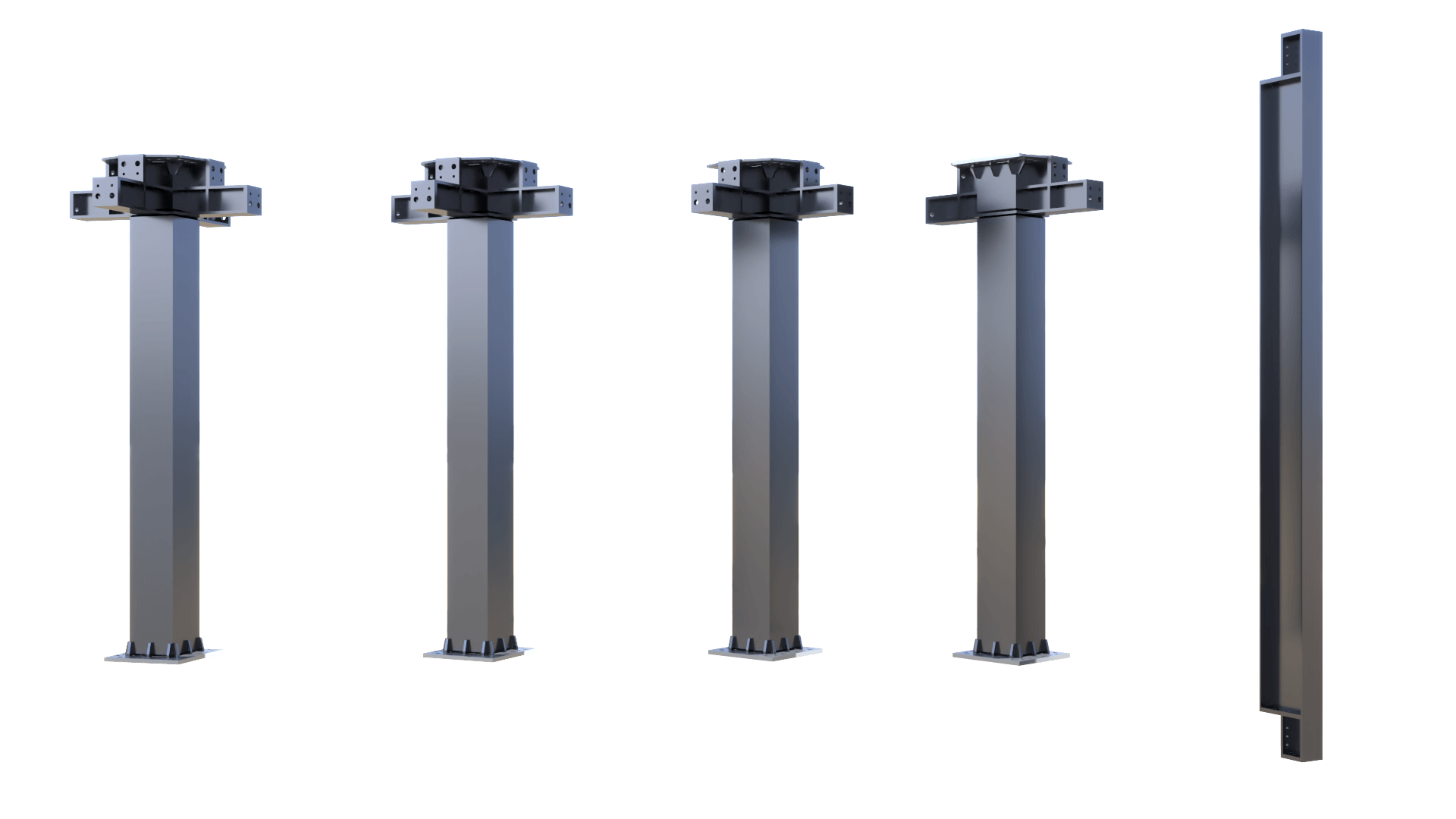
Against this backdrop, traditional welded PEB’s market footprint keeps shrinking, and full-bolt prefabricated steel emerges as the optimal solution aligned with updated industry benchmarks. Developed in line with global steel construction evolution routes, HHBT’s proprietary SEP full-bolt prefabricated building system directly addresses prevailing Middle Eastern construction pain points.
All SEP structural components undergo precision machining and pre-inspection inside factories before shipment, completely eliminating field welding defects triggered by harsh weather. On-site installation is limited to mechanical bolt assembly, slashing certified welder demand by over 30% and cutting main construction duration by 40%~60%.
The SEP system has completed professional seismic testing at Tsinghua University, featuring uniform joint rigidity and superior structural stability versus conventional welded PEB. Its Gulf-specific anti-corrosion formulation delivers long-term integrity under harsh ambient conditions and drastically cuts full-lifecycle maintenance spending.
Furthermore, the weld-free workflow fully satisfies GCC carbon and green building regulations. As the industry undergoes widespread transformation, the SEP full-bolt system fills the critical mid-market gap for efficient, eco-friendly industrial buildings.
Closing Remarks
Driven by national industrial policies, stricter certification rules and shifting client procurement logic, outdated field-welded PEB is set for gradual market elimination across the GCC. Industrially prefabricated bolt-connected steel construction stands as the inevitable development direction, with solution providers equipped with climate customization and smooth certification capabilities poised to capture emerging market dividends.
Source Disclaimer
All statistical data and industry analysis within this article are sourced from 2025–2026 public research reports issued by World Steel Association, World Bank, Mordor Intelligence, Technavio and authoritative GCC industrial institutions, for industry reference only。
About HHBT
We are HHBT, a pioneering company founded in 2019. We provide end-to-end construction solutions, from digital design to smart manufacturing and final assembly, redefining architectural industry with greater efficiency, precision, and sustainability.
Learn more about our SEP system: https://www.yourwebsite.com/sep-system